 (613) 454-1577
 Request Service




How To Tell If Your Oven Temperature Sensor Is Broken

Nothing is worse than following a family recipe perfectly only to pull out raw or completely burnt food. For residents in our region, winter baking is a massive local tradition. When the temperature drops outside, spending the weekend baking tourtiere or preparing a massive holiday turkey is how many families stay warm and connected. However, if your baking projects are failing consistently and your cooking times are wildly unpredictable, you might be dealing with a faulty appliance component.
Discovering that your appliance is ruining expensive cuts of meat or delicate pastries causes major stress. Finding reliable Ottawa oven repair is the first step to saving your weekend meal prep and protecting your grocery budget. In this comprehensive guide, we will explore the exact symptoms of a failing oven temperature sensor and how to determine if your appliance needs a simple adjustment or a brand-new part.
What Is An Oven Thermistor And How Does It Work
Before you can diagnose a problem, you need to understand the mechanics of the machine. The oven temperature sensor is often referred to as a thermistor by appliance technicians. This component is typically a thin pencil-like metal probe that protrudes from the upper rear wall of the interior baking cavity. Its primary job is to monitor the internal ambient heat and communicate that data to the main electronic control board.
The sensor operates on a principle of electrical resistance. As the heat inside the baking cavity rises, the electrical resistance inside the metal probe changes accordingly. The main control board continuously reads this resistance to determine exactly how hot the space is at any given moment. If you are noticing inconsistent results with your baking and your surface burners are also acting erratically, you might need electric stove repair to address a combined electrical issue in your range.
The Role Of The Metal Probe Inside The Cavity
- The probe acts as the primary thermostat for the entire appliance.
- It sends continuous electrical resistance readings to the main computer.
- The control board uses this data to cycle the baking element on and off.
- It ensures the cavity maintains an average heat matching your dial setting.
- A failing probe will lie to the computer and cause massive temperature swings.
Why Does My Oven Take So Long To Preheat
If you are constantly asking why your oven takes so long to preheat, the sensor is the most likely culprit. When the probe begins to fail, it struggles to send the correct resistance signal to the control board. It might register that the interior is three hundred degrees when it is actually only two hundred degrees inside. Because the computer thinks the appliance is already hot, it shuts off the heating element prematurely. This constant miscommunication causes the preheating cycle to drag on endlessly, completely ruining your dinner schedule.
The Multimeter Resistance Test
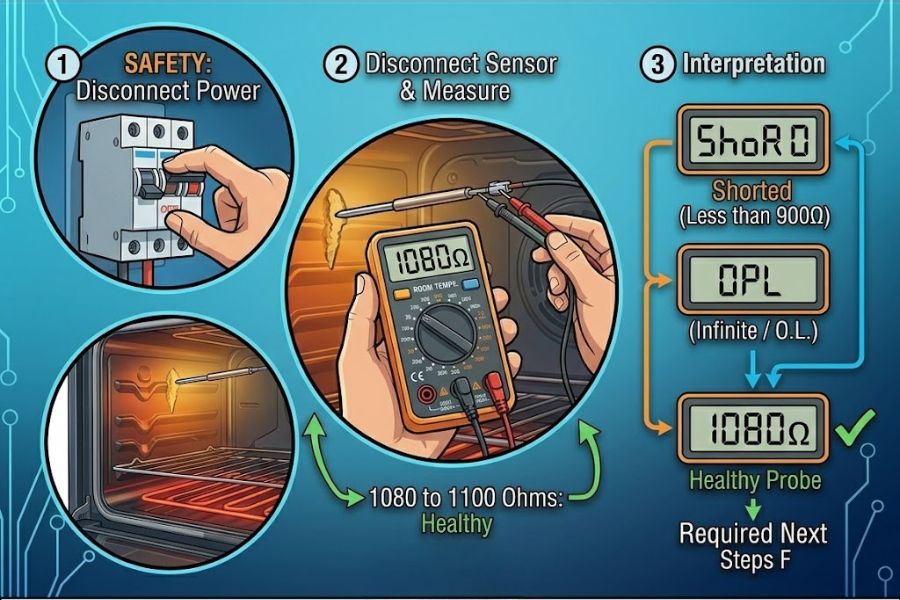
Professional technicians do not guess when it comes to electrical failures. They use specific diagnostic tools to prove exactly which component has stopped working. The standard method for testing an oven temperature sensor involves using a digital multimeter to measure its electrical resistance in Ohms. By pulling the sensor out of the back wall and touching the multimeter leads to its wire terminals, a technician can see immediately if it has failed.
A healthy modern sensor should measure approximately one thousand and eighty Ohms of resistance at room temperature. If the multimeter reads open infinite resistance or shorted zero resistance, the probe is completely dead and must be replaced. This technical diagnostic approach is exactly why relying on appliance repair services is always the safest and most cost-effective bet for high-voltage equipment.
Diagnosing The Issue Like A Professional
- Always disconnect the main power breaker before touching any internal wires.
- Remove the mounting screws holding the metal probe to the rear wall.
- Carefully pull the wire harness through the insulation to expose the plastic connector.
- Disconnect the plastic plug and set your multimeter to the Ohms setting.
- Touch the testing probes to the metal terminals inside the connector block.
Measuring Ohms At Room Temperature
| Multimeter Reading | What The Reading Means | Required Next Steps |
|---|---|---|
| 1080 to 1100 Ohms | The probe is healthy and functioning perfectly | Look for a failure in the main control board instead |
| Less Than 900 Ohms | The probe has shorted out internally | Replace the sensor to restore correct heating |
| Infinite or O.L. | The internal wire has completely snapped | Install a brand new OEM temperature probe immediately |
Understanding these electrical readings is crucial for a successful repair. If you are already experiencing strange electrical issues throughout your home, such as a laundry machine taking hours to finish a cycle, having a dryer repair technician check your incoming voltage levels is a smart preventative measure. Consistent electrical surges can easily fry sensitive temperature sensors across multiple appliances.
Main Control Board Relays Failing
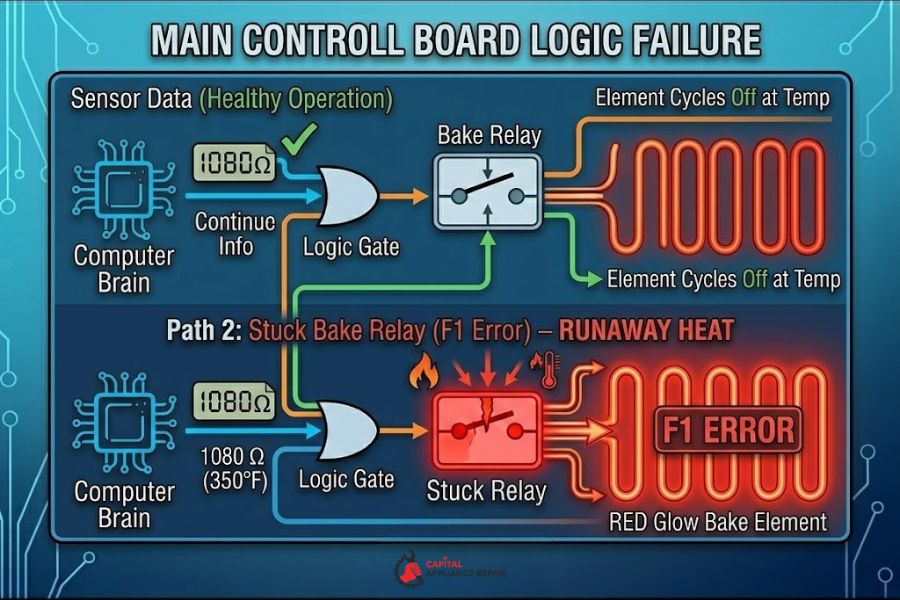
Sometimes the diagnostic test reveals a plot twist. The sensor tests perfectly at the correct room temperature resistance, but the appliance is still burning everything to a crisp. This means the sensor is fine but the brain of the machine is broken. The main electronic control board uses small electrical switches called relays to send high voltage power to the baking or broiling elements.
Over years of heavy use, these mechanical relays can actually fuse together and stick in the closed position. If this happens, the heating element stays on maximum heat continuously, completely ignoring the data coming from the temperature probe. We provide complete KitchenAid appliance repair for complex board issues just like this. High end brands utilize highly sophisticated electronic control boards to run their true convection and multi rack baking features, requiring a trained expert to safely diagnose them.
When The Brain Of The Appliance Breaks
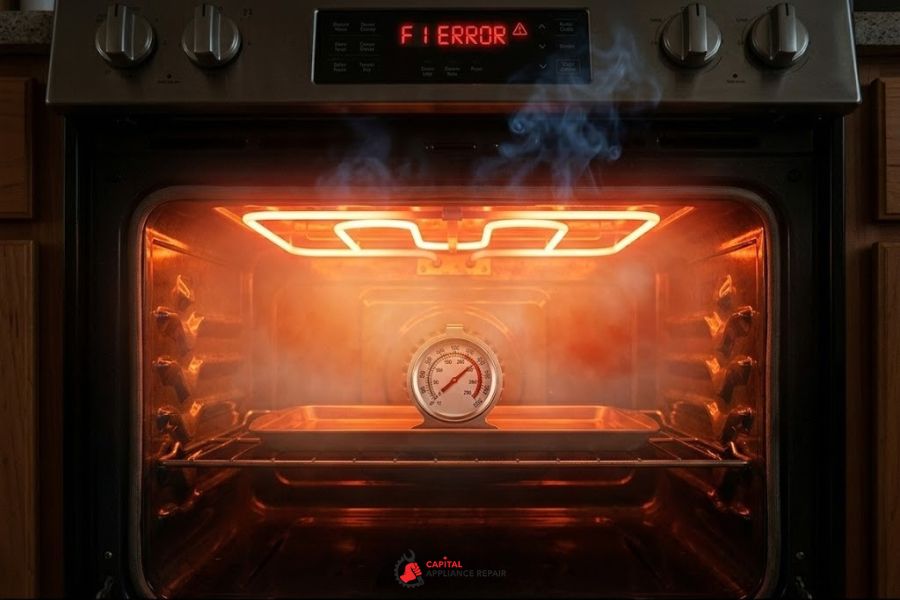
- The baking element glows bright red and refuses to turn off even when the cycle ends.
- You have to flip the main circuit breaker to stop the appliance from heating.
- The digital display throws an F1 or F3 error code indicating a runaway temperature.
- You hear a loud buzzing or clicking sound coming from behind the digital clock.
- The internal cooling fan runs constantly, but the heat never regulates.
Recognizing A Stuck Bake Element Relay
A stuck relay is more than an inconvenience; it is a severe safety and fire hazard. The appliance will continue to heat until the internal thermal fuse eventually blows to prevent a catastrophic fire. This failure is very similar to when a cooling compressor runs nonstop, and you need refrigerator repair services to swap a faulty starter relay. Replacing an electronic control board requires professional hands to ensure all wire harnesses are seated correctly and safely.
Calibrating Vs Replacing Parts
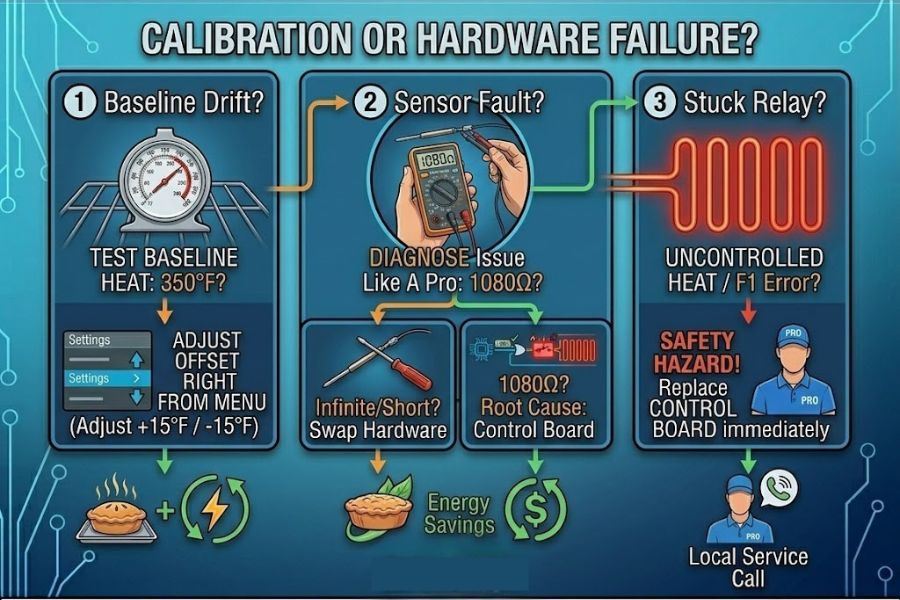
Not every heating issue requires a brand new part. Sometimes, your appliance simply needs to be recalibrated. Over the years, the baseline calibration of the control board can drift slightly. If your recipes are taking just five or ten minutes longer than usual, your appliance might only be off by fifteen or twenty degrees. Most modern digital ranges allow you to adjust the temperature offset right from the main settings menu.
Before you start taking your kitchen apart, you should purchase a high-quality manual analog thermometer and place it in the center of the middle rack. Turn the heat to three hundred and fifty degrees and wait thirty minutes. Read the Epicurious guide to oven temperature calibration to learn exactly how to test your baseline and adjust your digital settings offset. Proper calibration is the easiest way to ensure your weekend baking projects turn out perfectly every single time.
When To Adjust And When To Swap Hardware
If adjusting the offset by thirty degrees still does not fix your raw food problem, the hardware has officially failed and must be replaced. Relying on a broken machine is dangerous for your family. If you need to make sure your holiday poultry is fully cooked despite an unreliable appliance, you must always follow the temperature guidelines and use a digital meat probe to avoid foodborne illness.
Do not guess when it comes to the safety of your food or your home wiring. If your current unit is incredibly old and the replacement parts are no longer manufactured, our team can also assist with professional appliance installation for your brand new kitchen range. However, if you smell burning wire insulation or see sparks while attempting to test your sensors, stop immediately. That is an emergency appliance repair situation that requires immediate professional intervention to keep your home safe.


