 (613) 454-1577
 Request Service




What To Do When Your Washing Machine Won’t Drain
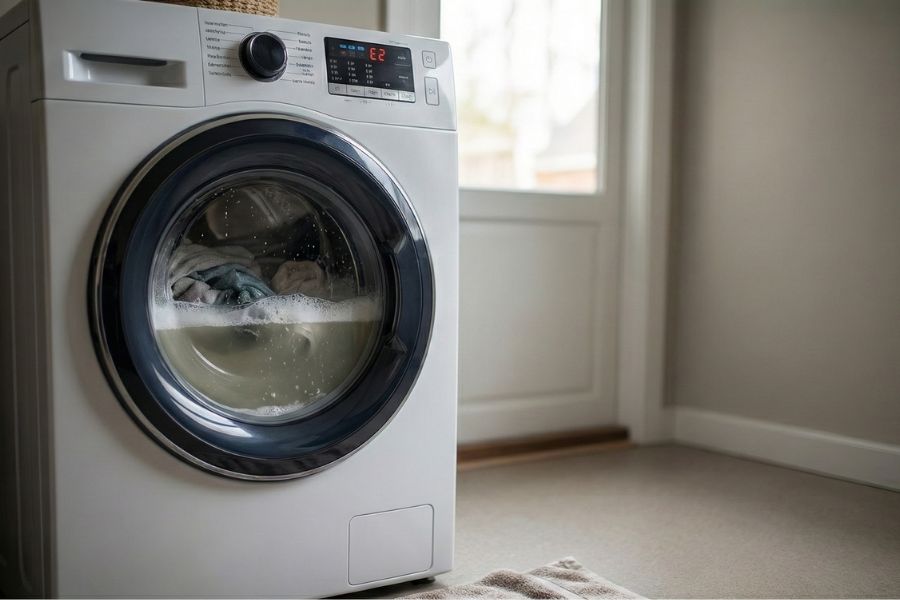
There are few things more frustrating in a busy household than opening your washer door to find your clothes floating in a pool of soapy, gray water. It usually happens at the worst possible time, right before a trip or when you need work uniforms ready for the next day. The panic sets in quickly: Why is there standing water? Is the motor broken? How am I going to get these wet clothes out? If your washing machine won't drain, you aren't alone. This is widely considered the single most common repair issue we encounter at Capital Appliance Repair. The good news is that not every drainage issue requires a completely new machine. In fact, many causes are simple maintenance issues you might be able to fix yourself.
In this detailed guide, we will walk you through the immediate steps to take, how to manually drain the water safely, common causes for drainage failures, and when it is time to call in a professional for washer repair services in Ottawa.
Immediate Safety Control When the Washing Machine Won't Drain
Before you grab a screwdriver or start pressing buttons frantically, you need to secure the area. Washing machines combine high-voltage electricity with water, a dangerous combination if handled incorrectly.
1. Power Down
If the machine is stuck mid-cycle and unresponsive, do not try to force the timer or dial. Unplug the machine from the wall immediately. If the plug is behind the machine and hard to reach, flip the breaker in your electrical panel. Never work on a "live" appliance, especially one filled with water.
2. Assess the Water Level
If the water is right up to the door glass on a front-loading machine, do not open the door. The weight of the water will push the door open violently once the latch releases, flooding your laundry room or kitchen floor. You will need to drain it manually first (see below).
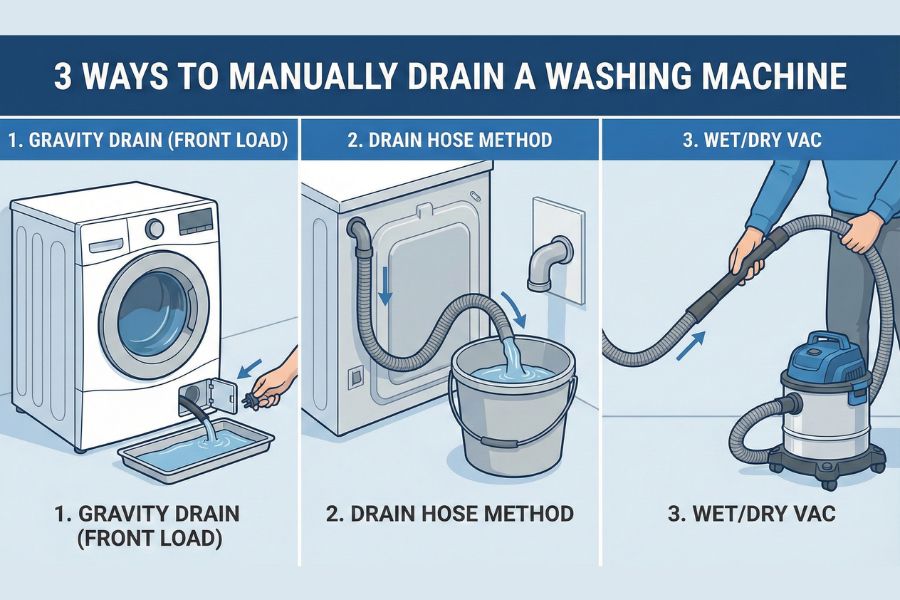
How to Manually Drain a Washing Machine
To troubleshoot why your washer full of water isn't emptying, you first need to get the water out. This allows you to inspect the filter and pump without making a massive mess.
- Method A: The Gravity Drain (Best for Front Loaders)
Most front-loading washers (like Samsung, LG, and Whirlpool) have a small access panel on the bottom front of the machine. Open this panel. You will often see a small rubber tube with a plug. Place a shallow tray or bowl under it, remove the plug, and let the water flow out. Replace the plug when the bowl is full, dump the water, and repeat until empty. - Method B: The Drain Hose Method
Pull the machine away from the wall gently. Locate the main gray corrugated drain hose. Disconnect it from the plumbing standpipe or sink. Keep the end raised high until you have a large bucket ready on the floor. Lower the hose into the bucket; gravity should force the water out. - Method C: Wet/Dry Shop Vac
If the gravity method fails (which suggests a severe clog deep in the machine), a wet/dry vacuum is your best friend. It can suck the water out through the drain hose forcefully.
Top 6 Reasons Why Your Washing Machine Won't Drain
Once the machine is empty, you can start the detective work. Why did this happen? Here are the most likely culprits, ranked from easiest to fix to most complex.
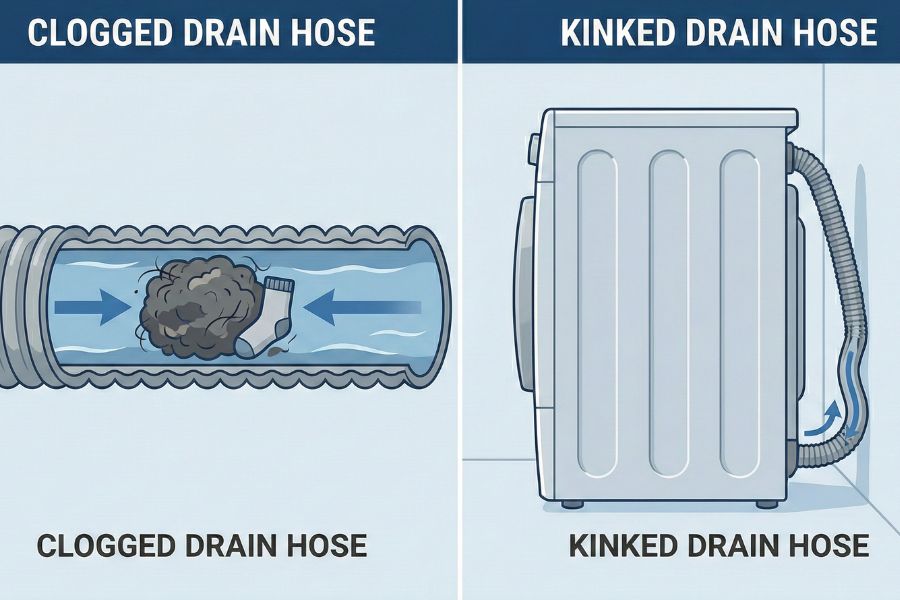
1. The Drain Hose is Kinked or Clogged
It sounds too simple to be true, but this happens frequently. If your washer was pushed back too hard against the wall, the flexible drain hose might be crimped, cutting off the flow of water.
The Fix: Pull the washer out and inspect the hose. If it is kinked, straighten it out. Also, check for clogs. Sometimes a small sock or a buildup of lint can get stuck in the exit of the hose. You can usually clear this with a long wire or by running water through it with a garden hose outside.
2. The Drain Pump Filter (The "Coin Trap") is Blocked
This is the number one reason for a washing machine not draining or spinning issues. Modern front-loaders and some top-loaders have a filter designed to catch debris before it hits the pump. It catches coins, bobby pins, lint, dog hair, and "colour catchers." If this filter is full, water cannot pass.
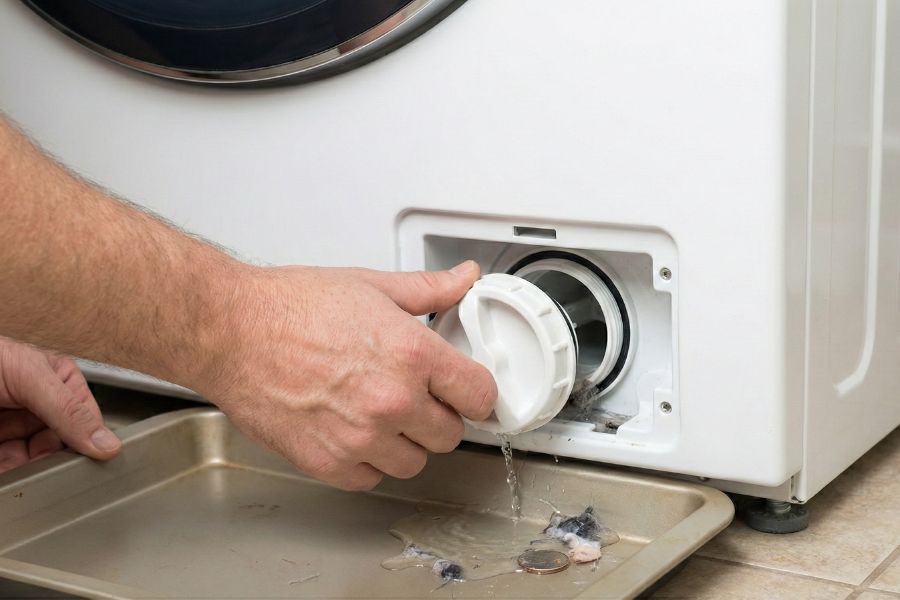
The Fix:
- Locate the access panel (usually bottom right or left).
- Place a towel down (residual water will come out).
- Unscrew the round filter cap counter-clockwise.
- Pull it out and clean off the debris. You might be shocked at what you find!
- Rinse it in the sink and screw it back in tightly.
3. The Drain Pump Has Failed
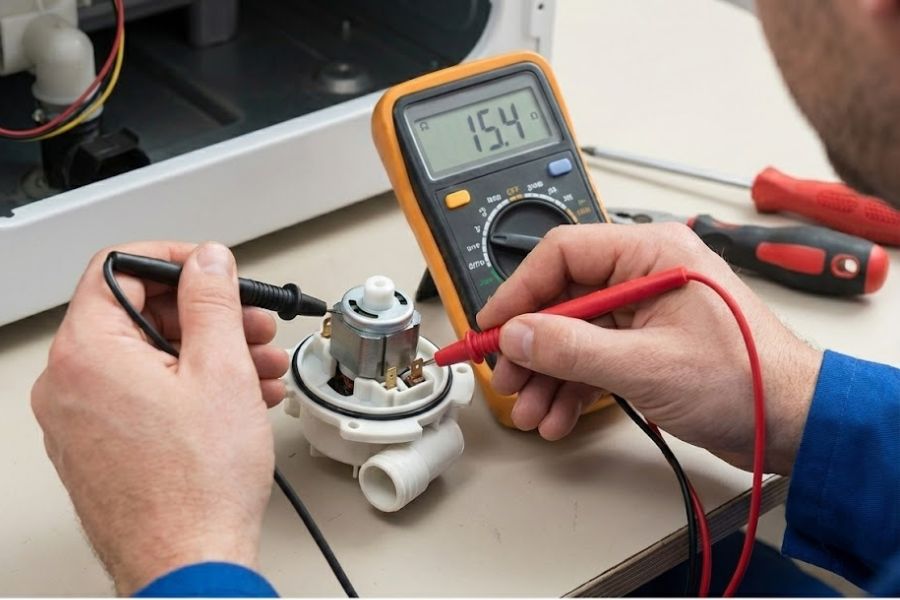
If the filter is clean and the hose is clear, but the washer still sits silent (or makes a low humming noise) when it should be draining, your drain pump might be broken. Pumps can fail mechanically (the impeller breaks) or electrically (the motor burns out).
The Symptoms:
- A loud grinding or gravelly noise during the drain cycle.
- A low hum but no water movement.
- Complete silence during the drain phase.
The Fix: This typically requires a part replacement. While some handy homeowners can swap a pump, it involves disassembling the cabinet. We recommend scheduling a service call with Capital Appliance Repair to ensure the correct OEM part is used.
4. Broken Lid Switch or Door Lock Assembly
Washing machines are programmed with safety interlocks. On a top-loader, there is a small plastic tab under the lid. If this tab breaks, or if the sensor fails, the machine "thinks" the lid is open. For safety reasons, most washers will not spin or drain if the lid is detected as open.
The Fix: Press the lid switch manually with a pen while the machine is on (carefully!). If the machine engages, the switch is just misaligned. If nothing happens, the switch likely needs to be replaced.
5. Clogged House Plumbing
Sometimes, the issue isn't the appliance at all. If your washing machine won't drain and you also notice the sink next to it draining slowly, or water backing up into the laundry tub, you likely have a blockage in your home's main plumbing pipes.
The Check: Pour a large bucket of water into the standpipe (the pipe the washer hose goes into). If it overflows instantly, you need a plumber, not an appliance technician.
6. Control Board Glitches
Modern appliances are essentially computers. Sometimes, a power surge or a software glitch can cause the main control board to stop sending voltage to the drain pump. If every mechanical part looks fine, the "brain" of the washer might be the issue.
The Fix: Try a "Hard Reset." Unplug the washer for 5 minutes. Plug it back in and try to run a "Drain/Spin" only cycle. If it works, it was just a glitch. If not, the board may be fried.
Brand-Specific Troubleshooting
While all washers operate on similar principles, some brands have unique quirks regarding drainage issues.
Samsung Washer Won't Drain
Samsung washers are notorious for "Nd" or "5E" error codes. You can verify your specific model's code on the official Samsung Support page, but this almost always points to a blocked debris filter.
Whirlpool/Maytag Washer Not Draining
Older Whirlpool direct-drive top loaders use a mechanical pump connected to the motor. If these stop draining, it is often because the lid switch has physically broken. On newer front loaders, look for the "F9 E1" error code, which indicates long drain times (clogs).
LG Washer Not Draining
LG machines will display an "OE" error code. This stands for "Output Error" (meaning water isn't outputting). LG drain hoses often have a "check valve" to prevent backflow; if this valve gets stuck with lint, the "OE" code will flash even if the pump is working.
The "Invisible" Culprit: Using Too Much Detergent
Believe it or not, using too much soap can prevent your machine from draining. This is called "Suds Lock."
If you use too much detergent, or non-HE detergent in a High-Efficiency machine, the wash drum fills with thick foam. The air in the foam prevents the water pump from creating a vacuum, meaning it spins air rather than water. The sensor detects the resistance and stops the cycle to prevent pump burnout.
How to check: If you see a wall of bubbles in the window, you have Suds Lock. Pour a cup of vinegar into the detergent dispenser and run a rinse cycle to kill the foam.
Should You Call a Professional For a Non-Draining Washing Machine?
While cleaning a filter is a great DIY task, other drainage issues require professional tools and expertise. You should call Capital Appliance Repair if:
- You have cleaned the filter and hose, but the water still won't drain.
- The pump is making loud grinding noises (indicating internal damage).
- You smell burning rubber or plastic (electrical shorts or belt friction).
- The water leaked onto the floor and you need to ensure internal components aren't water-damaged.
Attempting to replace a drain pump or control board without experience can lead to leaks that cause thousands of dollars in flooring damage. Our technicians carry common pumps and belts for all major brands, ensuring we can often fix the issue on the very first visit.
Why a Washing Machine that Won't Drain Requires Repair
A washing machine that won't drain is a major inconvenience, but it is rarely a catastrophe. By following the steps above, checking the hose, cleaning the coin trap filter, and listening for pump sounds, you can often diagnose or even fix the problem in under 30 minutes.
However, if you've tried the DIY tips and the water is still standing, don't let wet clothes sit and mildew. Contact the experts at Capital Appliance Repair. We serve Ottawa and the surrounding areas with same-day service availability to get your laundry routine back on track.
Frequently Asked Questions (FAQs)
Can I just bail the water out with a bucket?
Yes, for top loaders, using a bucket is the fastest way to lower the water level. However, you won't be able to get the water at the very bottom of the drum, which is where the pump inlet is. You will still need to use the drain hose or filter method to get the machine completely dry.
How much does it cost to fix a washing machine that won't drain?
If it is just a clog you clear yourself, it is free! If you require a professional, the cost depends on the part needed (e.g., a new pump vs. a new control board). At Capital Appliance Repair, we offer transparent, flat-rate pricing so you know exactly what to expect. Check our pricing page for more details.
Is it worth fixing a washer that won't drain?
Generally, yes. Drain pumps are relatively affordable parts compared to the cost of a new $1,000+ washing machine. Unless your machine is over 15 years old and has other issues (like a bad transmission or rust), repairing a drainage issue is usually the most economical choice.


